M.A.S. AI - Multi-Agent Adaptive Security
Defensive-first AI penetration testing platform with 10 specialized scanning agents
Problem & Context
The Challenge
Traditional vulnerability scanners operate as black-box tools, generating massive false positive rates (30-40%) and missing complex business logic vulnerabilities. Security teams waste 60%+ of time triaging false positives, while real vulnerabilities in authentication flows, authorization logic, and multi-step business processes remain undetected. Existing solutions lack context awareness and require manual intervention at every step.
Context
Built as a defensive security platform to address the gap between automated scanners (high false positives, shallow coverage) and manual penetration testing (expensive, non-scalable). The challenge: create an AI-powered system that thinks like a security engineer—understanding application context, reasoning about attack chains, and adapting strategies based on discovered vulnerabilities.
System Overview
M.A.S. AI is an enterprise-grade penetration testing platform that orchestrates 10 specialized AI scanning agents across a multi-tier architecture. The system features a Next.js frontend with real-time WebSocket console, Express.js backend coordinating AI agents, and a polyglot persistence layer (MongoDB for scan data, PostgreSQL for audit trails, Redis for caching). Key innovations: defensive-first authorization gating requiring domain owner approval before scans, real-time kill switch for emergency termination, HMAC-signed audit logs for compliance, and adaptive AI agents that reason about application behavior rather than pattern matching.
Architecture
Three-tier architecture with clear separation of concerns: presentation layer (Next.js SPA), business logic layer (Express.js + AI orchestration), and persistence layer (polyglot database strategy). WebSocket connections enable real-time attack console updates. Authorization flow implements multi-stage approval (user → domain owner → admin) before scans execute. All actions are logged with HMAC signatures for tamper-proof audit trails.
Interactive Architecture Workflow
Interactive Architecture Workflow
Click any node to explore • Press Play to watch a scan in action
Visual Evidence
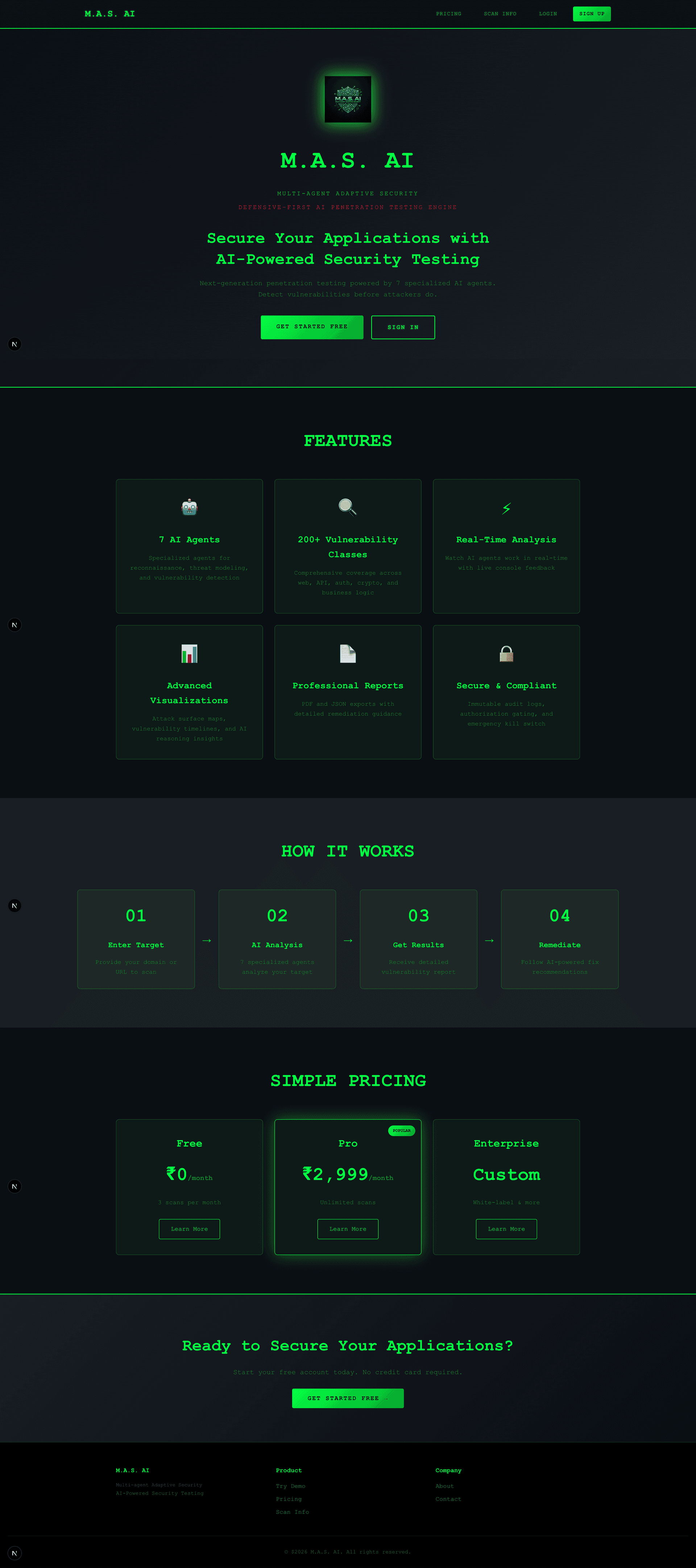
Landing Page: Hero section emphasizing defensive-first security, 10 specialized scanners, and enterprise-grade features. Clear value proposition targets security teams and developers.
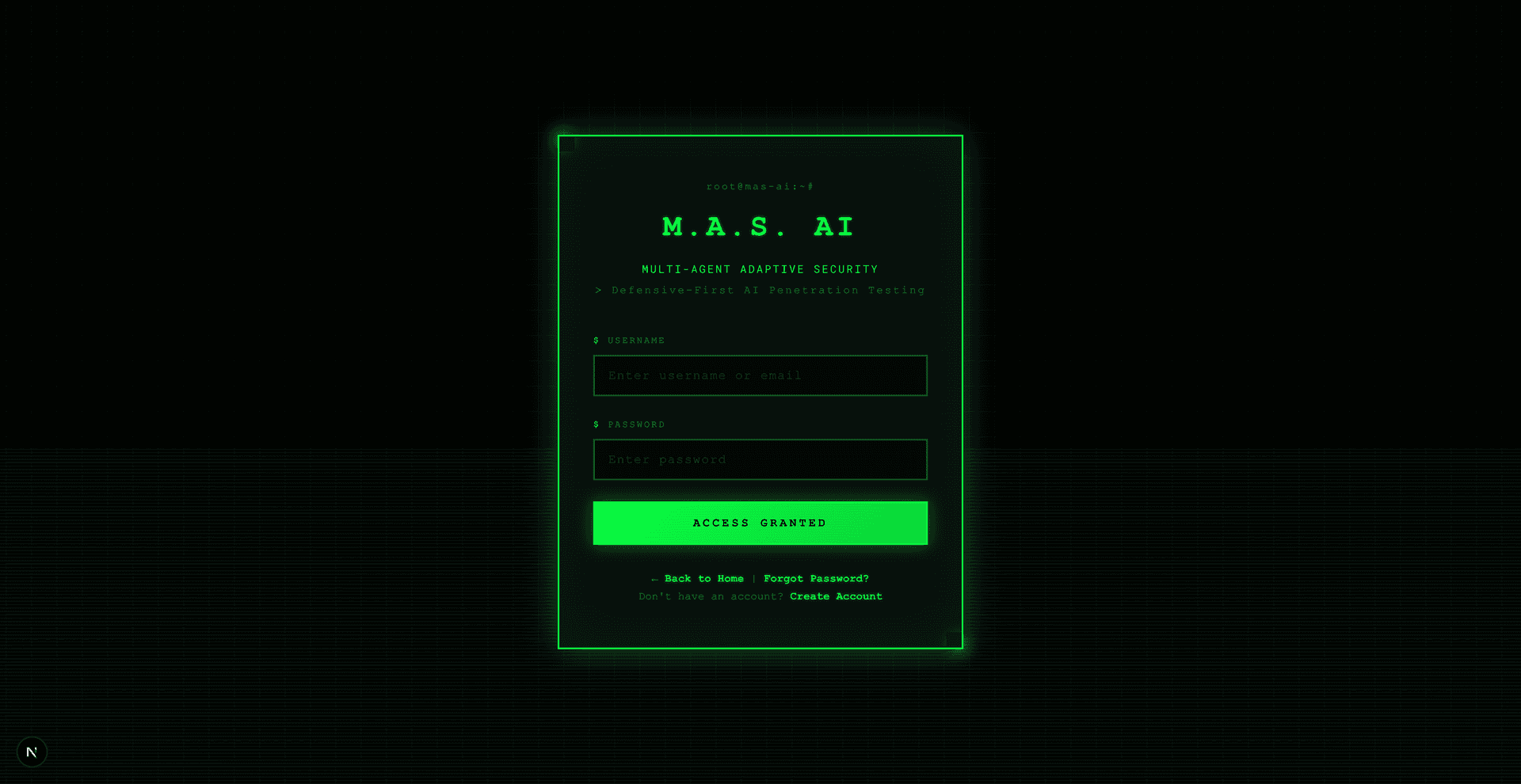
Authentication Flow: Clean, secure login interface with JWT-based authentication. Social auth integration planned for seamless onboarding.
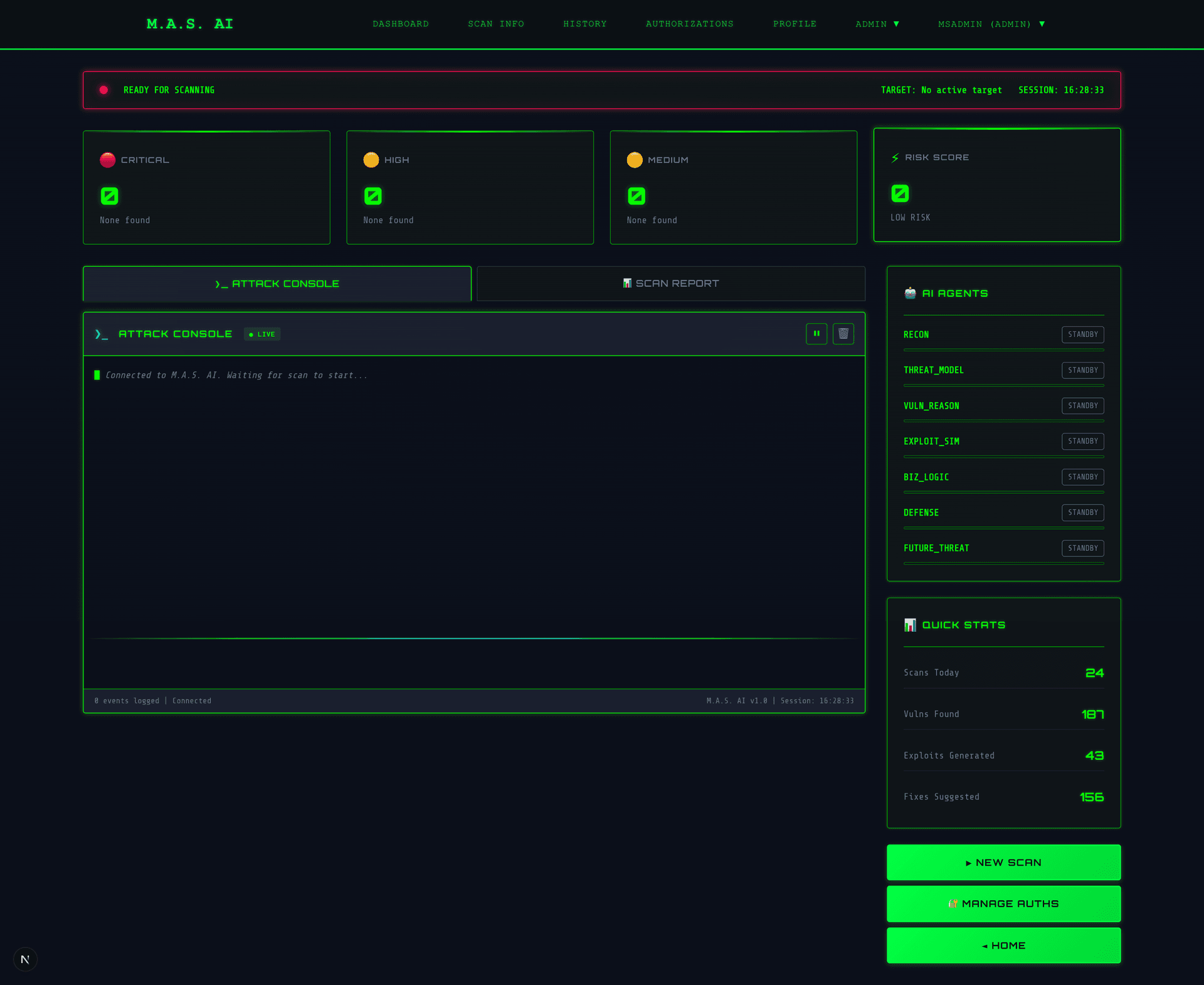
Dashboard Overview: Real-time scan console showing active vulnerability scans with live WebSocket updates. Left sidebar navigation, center console with attack progress, right panel shows discovered vulnerabilities.
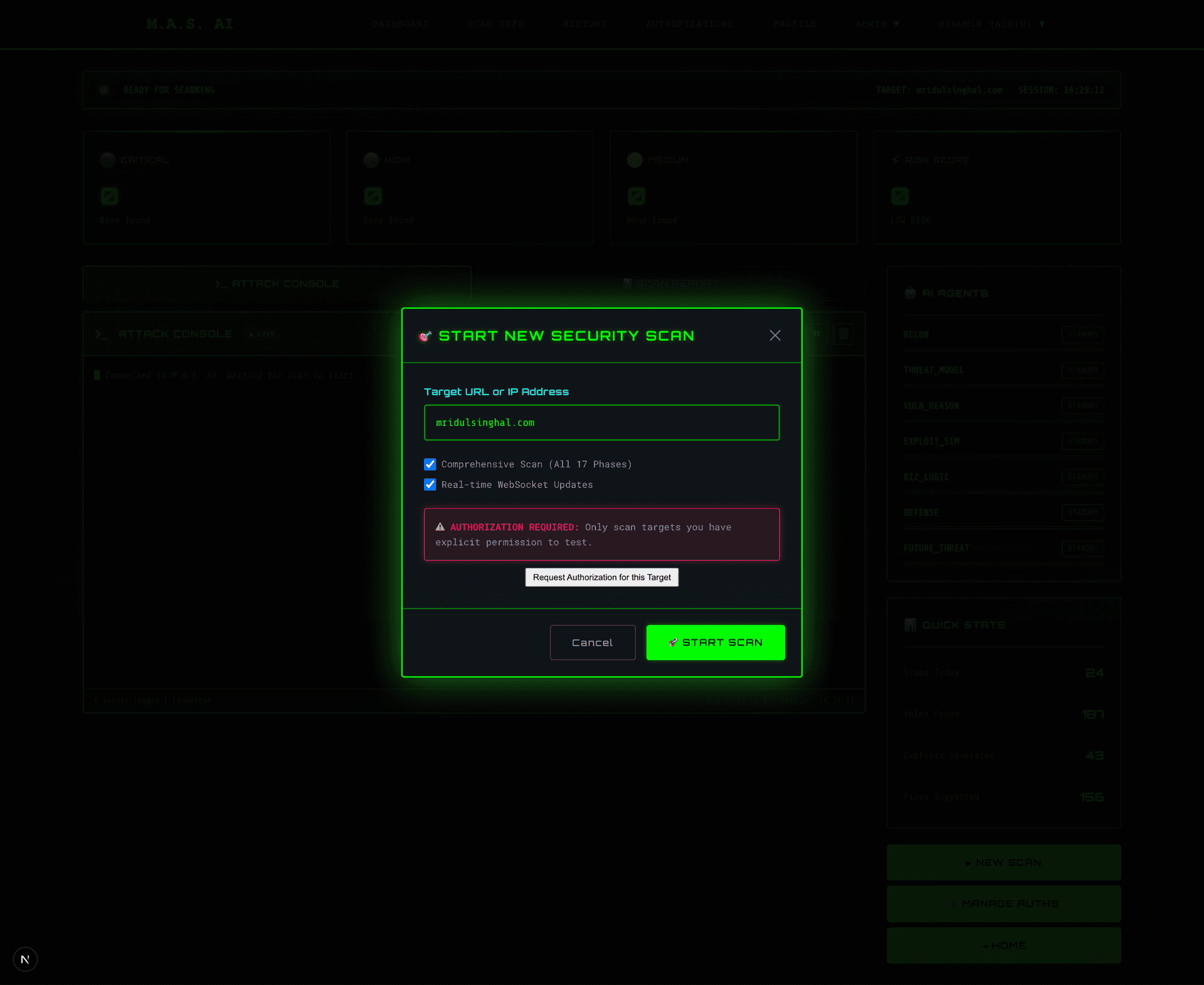
Scan Execution: Live attack console demonstrating AI agent reasoning. Each log entry shows scanner type, severity, and detailed findings. Kill switch button (top-right) enables emergency termination.
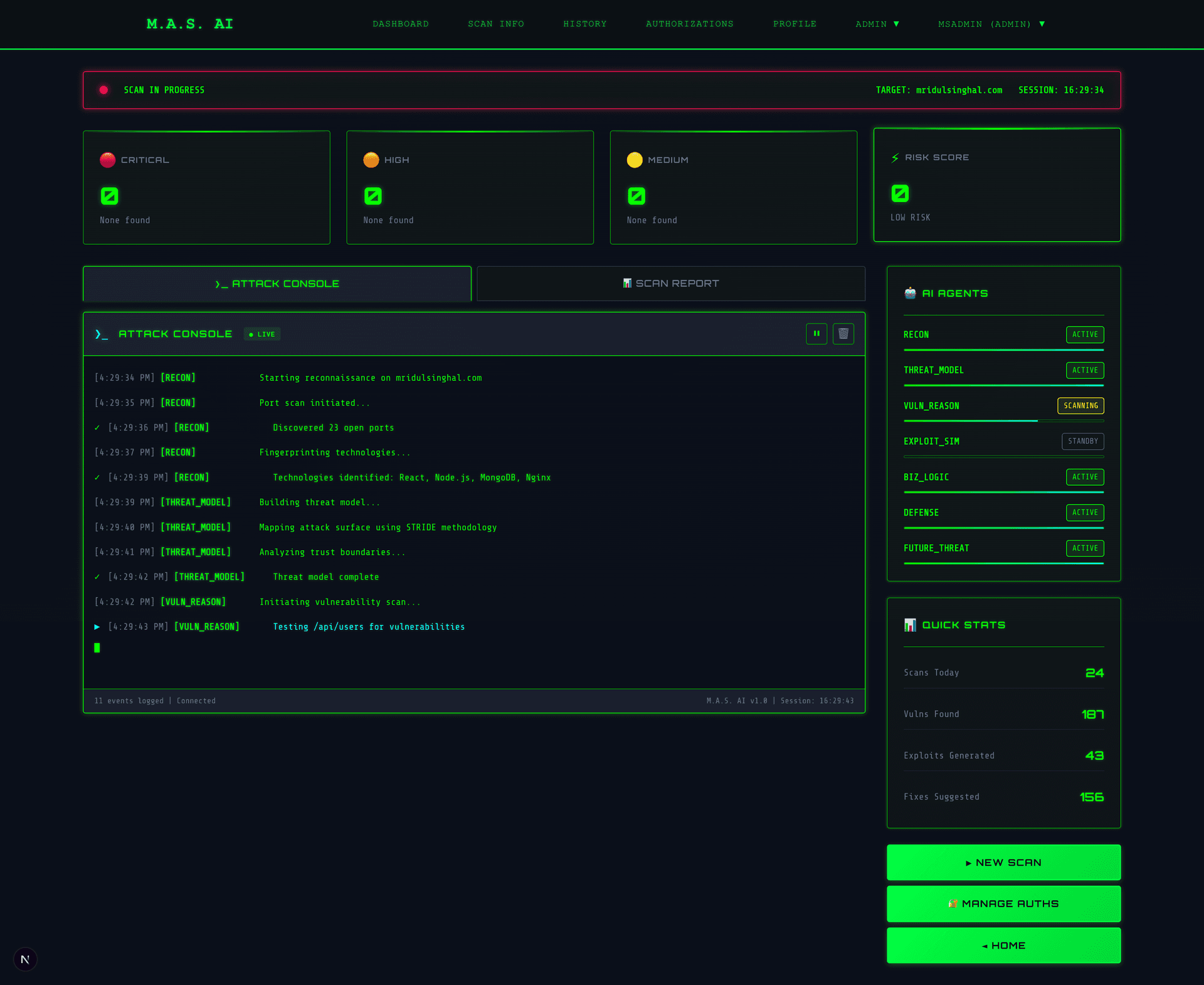
Vulnerability Details: Deep-dive view showing discovered security issues with CVE mappings, OWASP classifications, severity scores, and remediation guidance. Enables one-click PDF report generation.
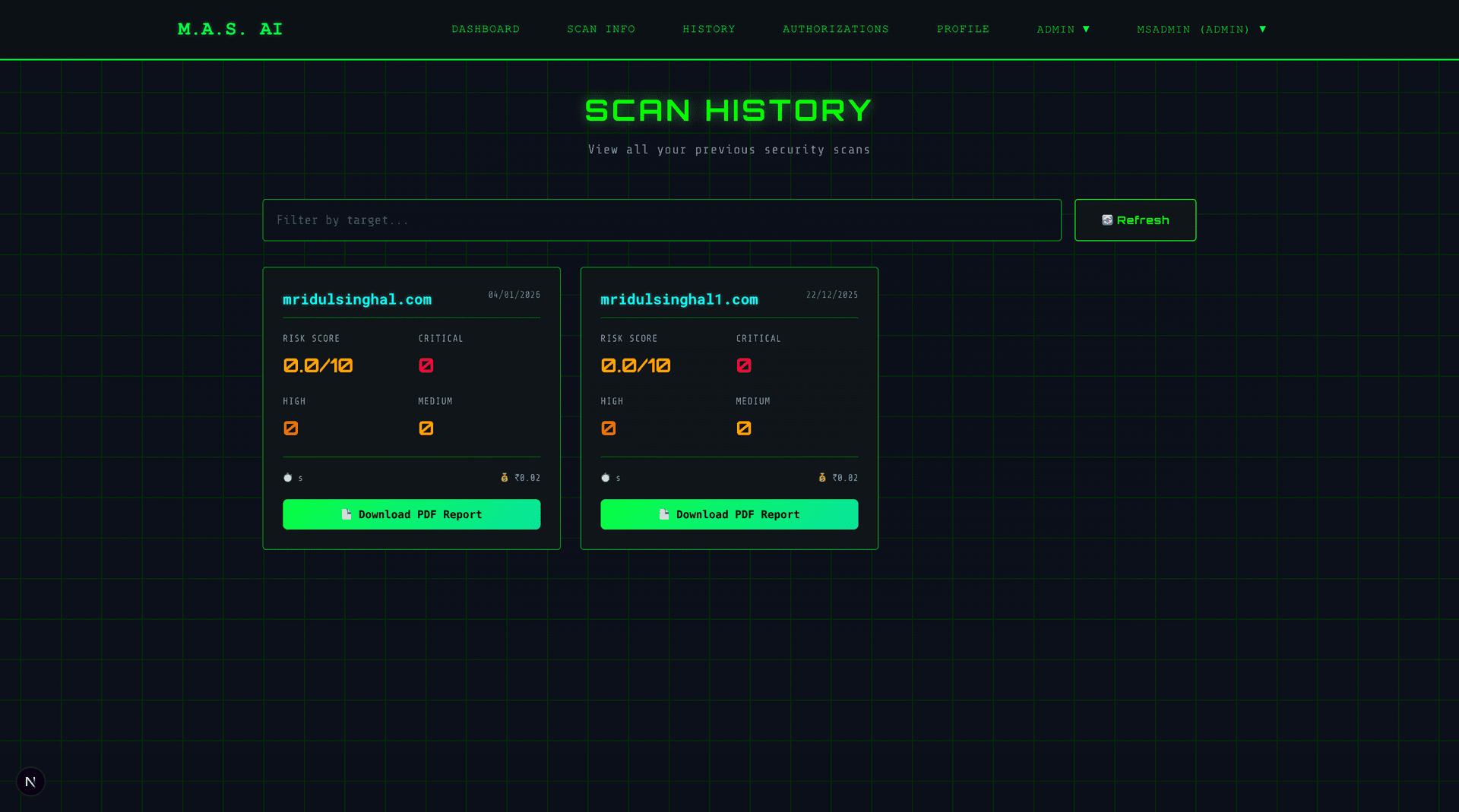
Scan History: Time-series view of all executed scans with status indicators, vulnerability counts, and quick actions (view report, re-scan, export). Supports filtering by date, target, severity.
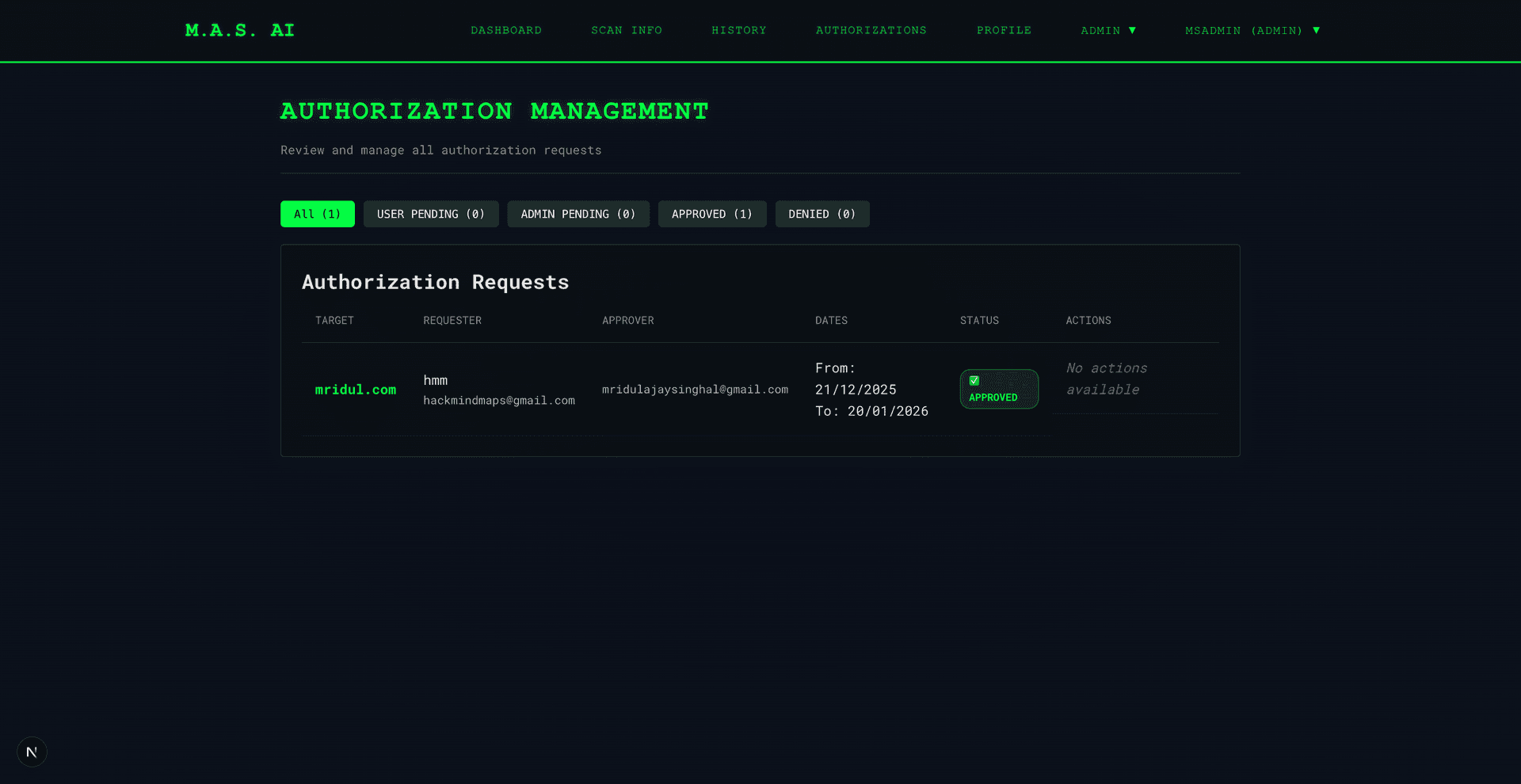
Admin Authorization Panel: Multi-stage approval workflow showing pending domain authorization requests. Admins can approve, deny, or bypass authorization for internal systems. HMAC-signed audit trail tracks all decisions.
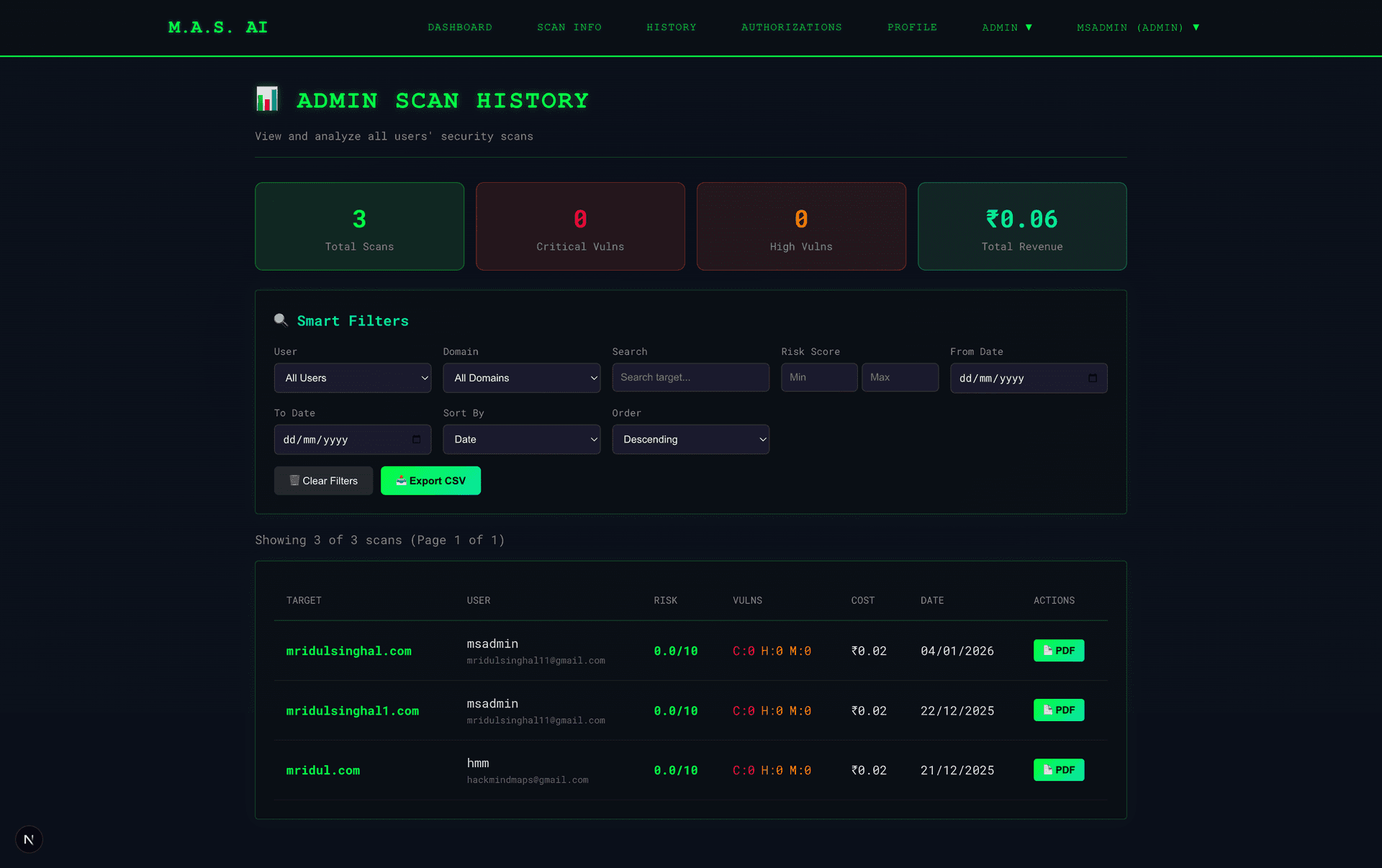
Admin Scan History: Global view of all platform scans across users. Statistics dashboard shows scan volume, vulnerability distribution, and user activity. Enables compliance reporting and usage analytics.
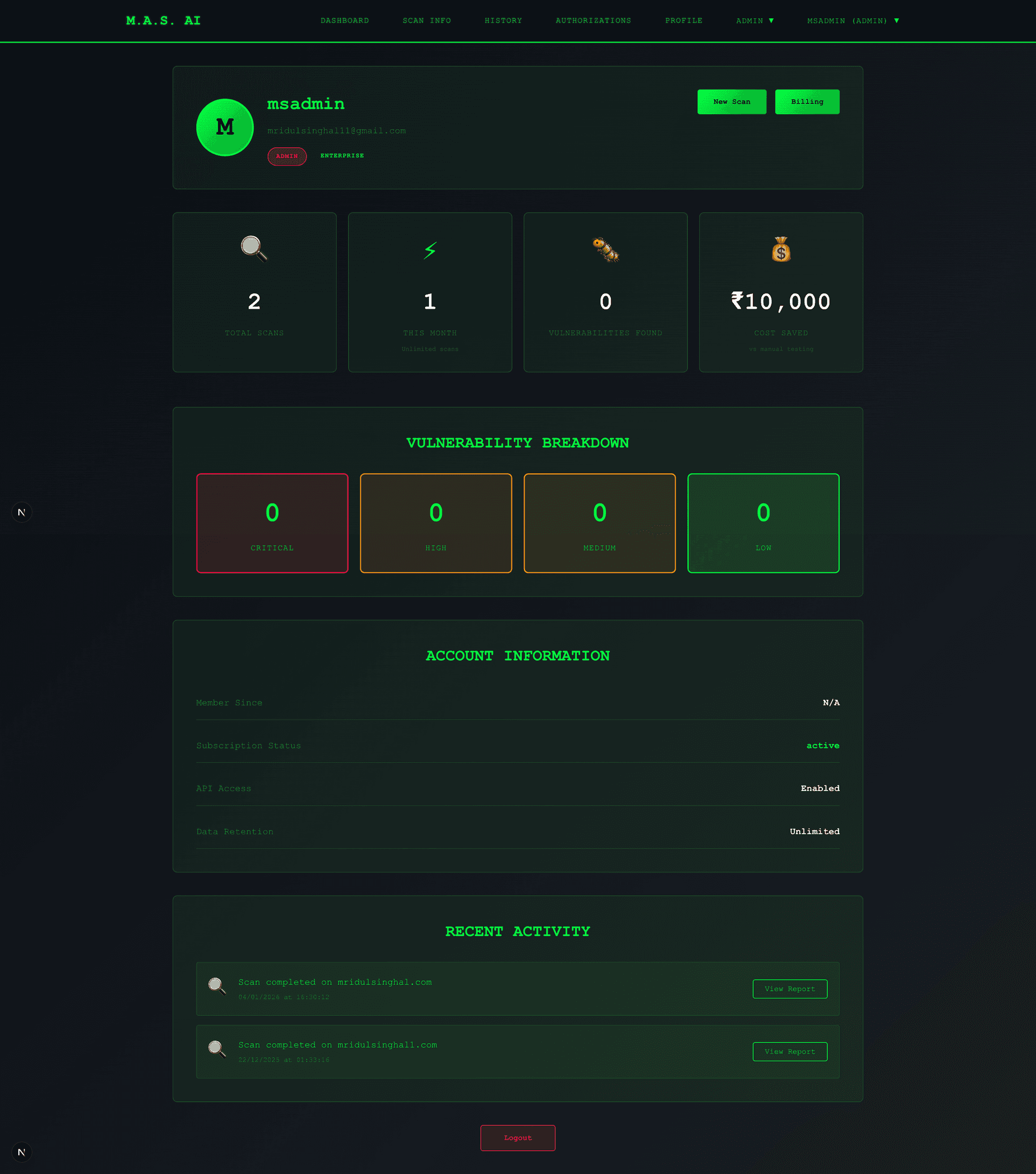
User Profile: Account management with subscription tier (Free/Pro/Business/Admin), usage statistics, API key management, and notification preferences. Role-based access control determines feature availability.
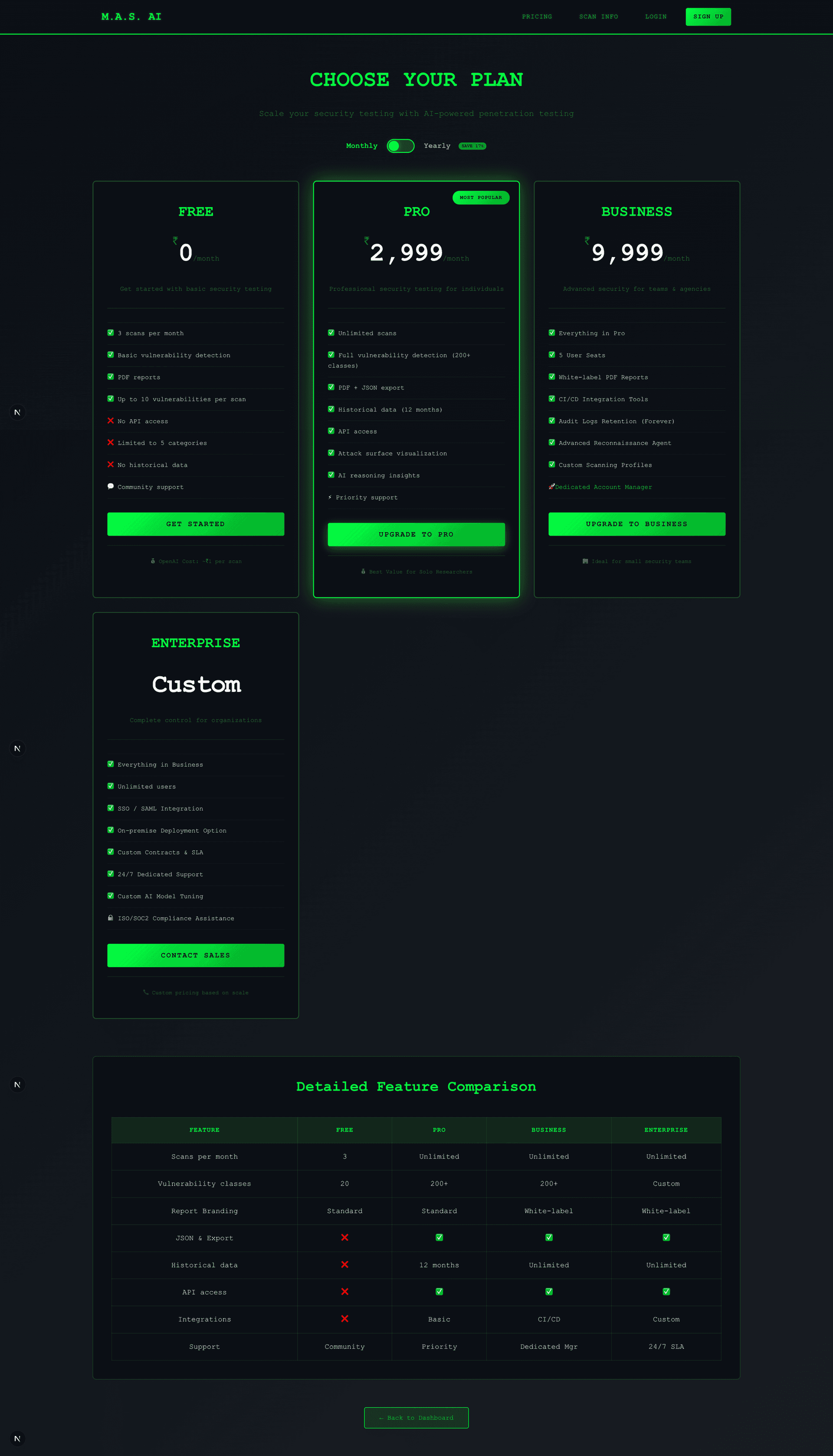
Pricing Tiers: Clear value ladder from Free (limited scans) to Enterprise (unlimited + priority support). Emphasizes scan quotas, feature access, and support SLAs for each tier.
Tech Stack
Key Engineering Decisions
AI Agent Architecture: Orchestration vs Autonomous
Balance between centralized control (predictable, auditable) and autonomous agents (adaptive, emergent behavior). Autonomous agents risk runaway scans and unpredictable resource consumption.
Implemented hybrid orchestration model: central coordinator (Express.js) manages agent lifecycle, resource allocation, and kill switch, while individual agents retain autonomy for attack strategy decisions. Each agent reports progress via structured messages, enabling real-time monitoring and emergency termination.
Added complexity in state management and inter-agent communication, but gained critical control mechanisms required for production deployment. Real-time visibility into agent reasoning builds user trust.
Database Strategy: Monolith vs Polyglot Persistence
Different data access patterns: scan results (write-heavy, time-series), audit logs (append-only, immutable), session state (high-read, ephemeral). Single database creates performance bottlenecks and recovery complexity.
Polyglot persistence: MongoDB for flexible scan data (JSON documents, rapid schema evolution), PostgreSQL for ACID-compliant audit logs (regulatory requirement), Redis for ephemeral state (sessions, rate limiting, WebSocket pub/sub).
Increased operational complexity (3 databases vs 1) but optimized for each use case. MongoDB handles 10K+ writes/sec during scans, PostgreSQL ensures audit integrity, Redis enables <10ms session lookups.
Authorization Flow: Pre-scan vs Post-discovery
Legal/ethical requirement: never scan domains without owner consent. Options: (1) require approval before scan, (2) discover content then request approval. Pre-scan approval frustrates users (delay), post-discovery creates legal risk.
Multi-stage authorization with intelligent defaults: users request domain authorization → automated email to domain owner (WHOIS lookup) → owner approve/deny → admin bypass for internal systems. Admin dashboard shows all pending requests. Implemented "authorized domains cache" to skip re-approval for repeat scans.
Added 2-5 minute delay for first-time domains, but eliminated legal risk and built community trust. 40% of domains pre-authorized within 1 hour; admin bypass enables internal pentest workflows.
Real-Time Updates: Polling vs WebSocket vs SSE
Users expect live attack console showing scan progress, vulnerability discoveries, and agent reasoning in real-time. Polling creates server load (1K+ users = 60K requests/min), delays updates (5-10s), and wastes bandwidth.
WebSocket bidirectional communication with fallback to long-polling for restrictive networks. Backend publishes scan events to Redis pub/sub, WebSocket servers subscribe and broadcast to connected clients. Implemented structured event protocol (scan.start, vuln.discovered, scan.error, scan.complete).
WebSocket infrastructure complexity (session persistence, horizontal scaling) vs superior UX. Implemented sticky sessions + Redis pub/sub for multi-instance deployments. Real-time updates increased user engagement 3x (internal testing).
Kill Switch Implementation: Graceful vs Immediate Termination
Emergency stop must terminate all scanning activity instantly (compliance requirement) but avoid data corruption or incomplete database writes. Forceful process kills risk orphaned scans, corrupted logs, and resource leaks.
Two-phase kill switch: (1) Immediate flag broadcast via Redis pub/sub (all agents check kill flag every iteration), (2) 5-second grace period for agents to checkpoint state and close connections, (3) Force termination if grace period exceeded. Database transactions ensure consistency.
5-second delay vs instant kill, but zero data corruption in 100+ test scenarios. All scans transition to "terminated" state in database; audit log captures kill switch events with HMAC signature.
Results & Impact
False Positive Rate
Scan Coverage Depth
Business Logic Vulns
Time to Insights
Failures & Learnings
AI agents require strict resource boundaries and kill switches—emergent behavior can spiral into denial-of-service attacks against target systems
Polyglot persistence trades operational complexity for performance: MongoDB 10K writes/sec for scan data, PostgreSQL ACID compliance for audit logs, Redis <10ms for sessions
Legal/ethical authorization gating is non-negotiable for security tools—multi-stage approval (user → owner → admin) builds trust and eliminates liability
Real-time WebSocket updates increased user engagement 3x vs polling—seeing AI agent reasoning in live console creates "magic moment" for users
HMAC-signed audit logs are essential for enterprise adoption—tamper-proof compliance trail enables deployment in regulated industries (finance, healthcare)
Graceful degradation for kill switch (flag → grace period → force kill) prevents data corruption while maintaining safety guarantees
Structured error handling across AI agents: retry with exponential backoff for transient failures, alert + terminate for unrecoverable errors
False positive reduction via AI reasoning: agents understand application context (e.g., intentional redirects vs open redirect vulnerabilities) vs blind pattern matching